

What's it about?
Freeform optics presents unique challenges to designers and manufacturers. Understanding a vendor’s manufacturing and metrology capabilities is critical to designing and tolerancing a freeform surface that uses its physical features to aid in integration.
This paper will first detail where slope error originated from, what it represents and the role it plays in optical performance. The three attributes that make up a complete slope error specification will be discussed along with examples of a complete slope error specification. Finally, it will conclude with techniques for measuring slope error.
1. SLOPE ERROR: A REFINEMENT OF FORM ERROR
Specifying an optical component begins with choosing a combination of mechanical dimensions, optical material and surface shape to satisfy an existing system performance requirement1. Deviation from the nominal effects system performance.
Looking specifically at surface shape, deviation falls into one of two categories: uniform and nonuniform deviation. Uniform deviation is where the as-manufactured surface is uniformly offset relative to nominal, and power in spherical surfaces would be an example. Nonuniform deviation is anything else, and it can have a periodic or random structure. The broad term “irregularity” is applied here, and it represents the broad summation of all nonuniform deviations for a given, as-manufactured surface shape.
Bundling nonuniform deviations into irregularity had a historical origin. Before laser interferometers became common in the optical shop, the workhorse testing tool was the test plate. The optician would bring the test plate and the surface under test into close contact, and by interpreting the resulting Newton Rings the optician could appraise the irregularity of the surface. While the magnitude could be determined, stating what contributors existed in what ratios couldn’t be accurately done.
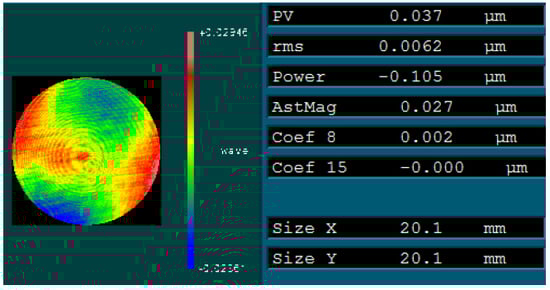
Figure 1
The rise of both interferometry and powerful computers for lens design software made it possible to break irregularity into its contributors and analyze individually the impact each would have on system performance. Magnitude as well as location and distribution of irregularity determined its significance. Figure 1 shows the output form fringe analysis software, and specifically shows the separation into contributors. The contributions of astigmatism (AstMag), third order spherical aberration (Coef 8) and fifth order spherical aberration (Coef 15) are shown separate from the traditional bundled peak to valley irregularity (PV).
Even though the nominal surface shape may have strong curvature and changes in curvature the form error is typically plotted relative to a horizontal line. The distance above or below the horizontal line represents the difference between nominal and actual form. Figures 2 -5 show how form transitions to form error.
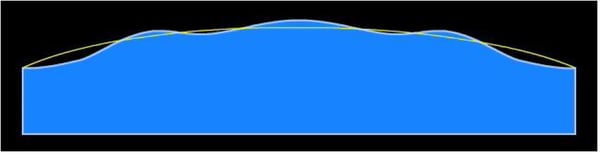
Figure 2 Actual versus perfect form on lens

Figure 3 Plot of actual versus perfect form

Figure 4 Actual form error versus perfect form error

Figure 5 Peak to valley form error
Controlling the rate of change in nonuniform deviation in addition to the magnitude is important to system performance2, especially those containing aspheric surfaces.3 The slopes resulting from midspatial (0.5 – 4mm) frequency errors subaperture polishing may cause can devastate system performance, and applying a maximum slope error specification to the traditional form error can control the contribution.
Slope error measurement is constructed in the following manner. For a given horizontal length, the increase or decrease in form error at the end point relative to the starting point is measured. The two values form a line, and angle it forms relative to horizontal (no form error) defines a slope: the larger the slope angle the larger the slope error. Figure 6 and 7 show how slope is measured using a small portion of the lens relative to its overall size.
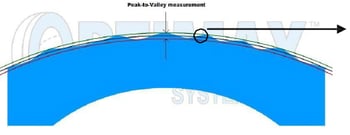
Figure 6 Lens Cross Section
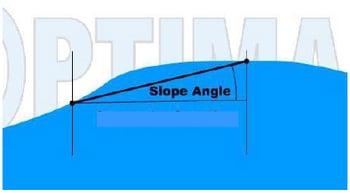
Figure 7 Enlarged Detail
2. COMPONENTS OF SLOPE ERROR SPECIFICATION
Slope error is calculated as a subset of the form error data, and it takes on a similar appearance. Likewise, slope error may be stated as Peak or RMS.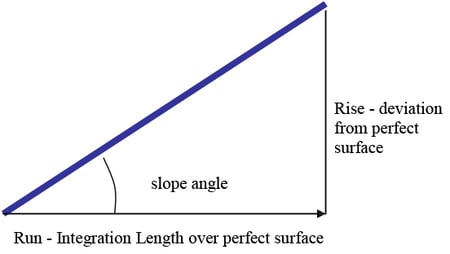
Slope error specification consists of three portions:
Integration Length: The lateral distance over which slope is averaged for every pixel in the measurement. Integration length cannot be larger than the clear aperture. Units are linear (µm, mm, in) units.
Slope Error: The average angular deviation (peak or RMS) of the local surface from the theoretical surface over the Integration length. Units are angular (arcmin, radian, degree) or linear (µm/mm, µin/in) units.
Sampling Spatial Resolution: The minimum resolution of the measurement. For an interferometer this would be pixel size. Integration length is made up of multiples of sampling length, and sampling length cannot be larger than one half the integration length. Units are linear (µm, mm, in) units.
At a minimum, a slope specification must contain at least the slope error and an integration length, and sampling length is included only when needed. The metrology device must provide coverage and resolution to meet the specified integration length. Using a table of 2-D or 3-D form error information slope error can be measured. Interferometric fringe analysis software can often perform the calculations directly4. Measurements can always be made graphically, plotting the data using appropriate scale.
3. SLOPE ERROR TOLERANCING SUMMARY
- Slope error specification is a refinement of form error
- Slope error measures the rate of change of form error
- A slope error specification must contain an integration length and the slope error (Peak or RMS)
- Slope error can be applied to the form error information of any surface under test
References
[1] W.J. Smith, Modern Lens Design, Pg 43, McGraw Hill, New York City, 2005
[2] R. N. Youngworth and B. D. Stone, "Simple Estimates for the Effects of Mid-spatial-Frequency Surface Errors on Image Quality," Applied Optics, 39, 2198 - 2200, 2000
[3] J.J. Kumler et al, “Measuring surface slope error on precision aspheres”, Proc. SPIE 6671, Pg 66710U (2007)
[4] MetroPro Reference Guide OMP-0347K, Page 10-24 and 3-94, Zygo Corporation, Middlefield, Connecticut, 2004
Optimax Systems
5 Feb 09
Sales Department