

What's it about?
This paper examines the role surface roughness plays in optical system performance, discusses the components of a surface roughness specification, and contrasts roughness with cosmetic defects.
1. SURFACE ROUGHNESS EFFECTS OPTICAL SYSTEM PERFORMANCE
In optical tolerancing, optical surfaces are often characterized in the spatial frequency domain1, events per some unit distance. In general, surface form error falls into one of three overlapping categories2, where each category represents a portion of the spatial frequency domain3. Figure, also known as irregularity in lens surfaces, represents an error at amacroscopic, full aperture, low spatial frequency level, while roughness looks at errors on a microscopic, sub-aperture, high spatial frequency level4. Figure 1 below illustrates the spatial frequency relationship between Figure and Roughness and the overlap in surface events. Midspatial errors occur between the Figure and Roughness categories.
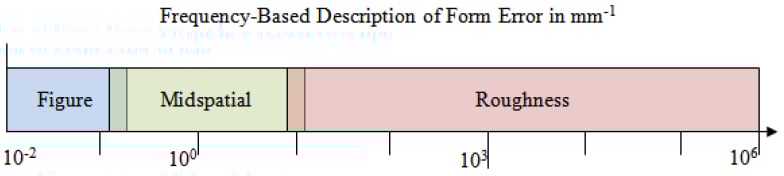
Figure 1 Spatial Frequency Relationship of Figure & Roughness
Surface roughness is a measure of topographic relief of the surface5, and it represents highly localized departures from desired form6. In the case of polished optics, roughness can stem from contamination, localized cosmetic defects called scratches and digs, and residual manufacturing artifacts7.
Surface roughness in an optical system influences the amount of wide-angle scatter. Wide-angle scatter produces a veiling glare which reduces image contrast or signal-to-noise ratio8, and is therefore to be avoided.
2. SPECIFYING SURFACE ROUGHNESS
All surfaces have some roughness9, and specifying a maximum allowable roughness limits light losses due to wide-angle scatter. This specification typically includes a maximum allowed roughness value and an associated spatial period or frequency10. When selecting the spatial component, the metrology must be considered because metrology tools operate over specific spatial frequency ranges.
Choosing Metrology
The specified spatial frequency must be within the sensitivity of the metrology tool to be meaningful11. Metrology devices are only useful for a given spatial regime12, and to fully characterize roughness it may be necessary to use multiple devices with overlapping spatial regimes.
Likewise, some devices are capable of a two dimensional line scan (X-Z measurement of a profilometer) measurement, while others are capable of measuring in three dimensions (X-Y-Z measurement using white light interferometry) to produce an areal scan. The line scan typically allows for a large spatial frequency range, but it presumes features are continuous. In a linear sense, the line scan typically covers more aperture than the areal measurement does. Areal measurements typically cover a smaller area on the aperture, but the data contains many more data points. Typically, the areal measurement covers higher frequencies than the line scan.
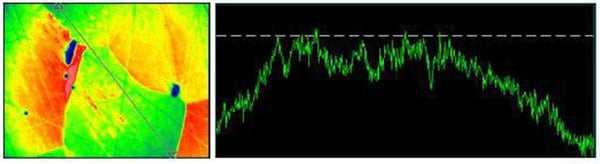
Figure 2 3-D Measurement and 2-D Trace
Figure 2 shows 3-D and 2-D surface roughness information for the same polished hard ceramic, where the 2-D information is a slice of the 3-D measurement. The two measurements show a 5x difference in RMS roughness, and the 2-D measurement shows none of the faceted appearance seen in the 3-D measurement.
Detailing A Roughness Specification
Roughness specification includes a maximum allowed roughness value AND the spatial bandwidth (either frequency or wavelength) over which it is to be met. ISO 10110 Part 8 offers some good starting points for spatial bandwidth specifications. Equivalently, an evaluation length (scan length or the area diagonal) could be specified in place of the spatial bandwidth. Sampling theory states evaluation length must at least twice the longest spatial wavelength. ISO 10110 has a 10 mm default scan length, which limits metrology options to 2-D line scan measurements. Accordingly, except for the two times wavelength, Optimax does not require any particular scan length and Optimax does not require ISO 10110 Part 8 be used to specify roughness. Specification depends on optical system performance requirements.
3. SURFACE ROUGHNESS VERSUS COSMETICS
A distinction must be made between surface roughness and cosmetic defects. Surface roughness refers to the overall texture distributed fairly uniformly over the whole surface13. Cosmetic defects, also referred to as scratch – dig, refers to highly localized and distinctly larger, more pronounced defects14 often imparted during handling and cleaning of the surface or residual from manufacture. They are specified separately15 and need to be treated separately.
4. CONCLUSIONS
- Surface roughness is form error on a microscopic, sub-aperture, high spatial frequency level.
- Surface roughness influences optical performance by reducing image contrast or signal-to-noise ratio. Specifying a maximum allowable roughness limits losses.
- Specification includes a maximum allowed roughness value, the spatial bandwidth over which it is to be met. In addition, the scan length or measurement should be specified. If not specified, the scan length will be two times the longest specified wavelength.
- Specified spatial bandwidth must be within the sensitivity of the metrology tool for meaningful surface roughness measurements.
- Surface roughness and cosmetic defects are specified separately and need to be treated separately.
References
[1] B. Braunecker, Advanced Optics Using Aspherical Elements, Pg 61, SPIE , Bellingham, WA, 2008
[2] "Optics and photonics - Preparation of drawings for optical elements and systems: Surface texture, roughness and waviness", ISO 10110-8, Section 1, 2010
[3] B. Braunecker, Advanced Optics Using Aspherical Elements, Pg 61 - 62, SPIE , Bellingham, WA, 2008
[4] Ibid
[5] J.M. Bennett, L. Mattsson, Introduction to Surface Roughness and Scattering, Pg 3, OSA, Washington. DC, 1993
[6] B. Braunecker, Advanced Optics Using Aspherical Elements, Pg 62, SPIE , Bellingham, WA, 2008
[7] J.M. Bennett, L. Mattsson, Introduction to Surface Roughness and Scattering, Pg 3, OSA, Washington. DC, 1993
[8] J.E. Harvey and A. Kotha, "Scattering effects from residual optical fabrication errors ", SPIE Proceedings - International Conference on Optical Fabrication and Testing, Vol 2576, Pg 155-174, SPIE , Bellingham, WA, 1995
[9] Ibid
[10] "Optics and photonics - Preparation of drawings for optical elements and systems: Surface texture, roughness and waviness", ISO 10110-8, Section 4.3.2, 2010
[11] J.M. Bennett, L. Mattsson, Introduction to Surface Roughness and Scattering, Pg 3, OSA, Washington. DC, 1993
[12] B. Braunecker, Advanced Optics Using Aspherical Elements, Pg 64, SPIE , Bellingham, WA, 2008
[13] "Optics and photonics - Preparation of drawings for optical elements and systems: Surface texture, roughness and waviness", ISO 10110-8, Section 4.1, 2010
[14] J.M. Bennett, L. Mattsson, Introduction to Surface Roughness and Scattering, Pg 3, OSA, Washington. DC, 1993
[15] "Optics and photonics - Preparation of drawings for optical elements and systems: Surface texture, roughness and waviness", ISO 10110-8, Section 3.1, 2010
Optimax Systems
17 Jun 11
Sales Department